
Description
SoilWatch 10
Stop replacing corroded sensors and upgrade to the SoilWatch 10. As the ultimate corrosion-resistant capacitive soil moisture sensor, it is the professional choice for Arduino, ESP32, and Home Assistant integration. While inferior resistive sensors fail within weeks due to oxidation, our advanced 75MHz capacitive technology ensures consistent, high-precision data without any electrode wear.
Engineered with a robust, fully-sealed housing, this waterproof soil probe handles extreme weather and long-term burial with ease. Whether you are building a smart garden or an industrial monitoring system, the SoilWatch 10 delivers professional-grade accuracy with zero maintenance and wide voltage compatibility.
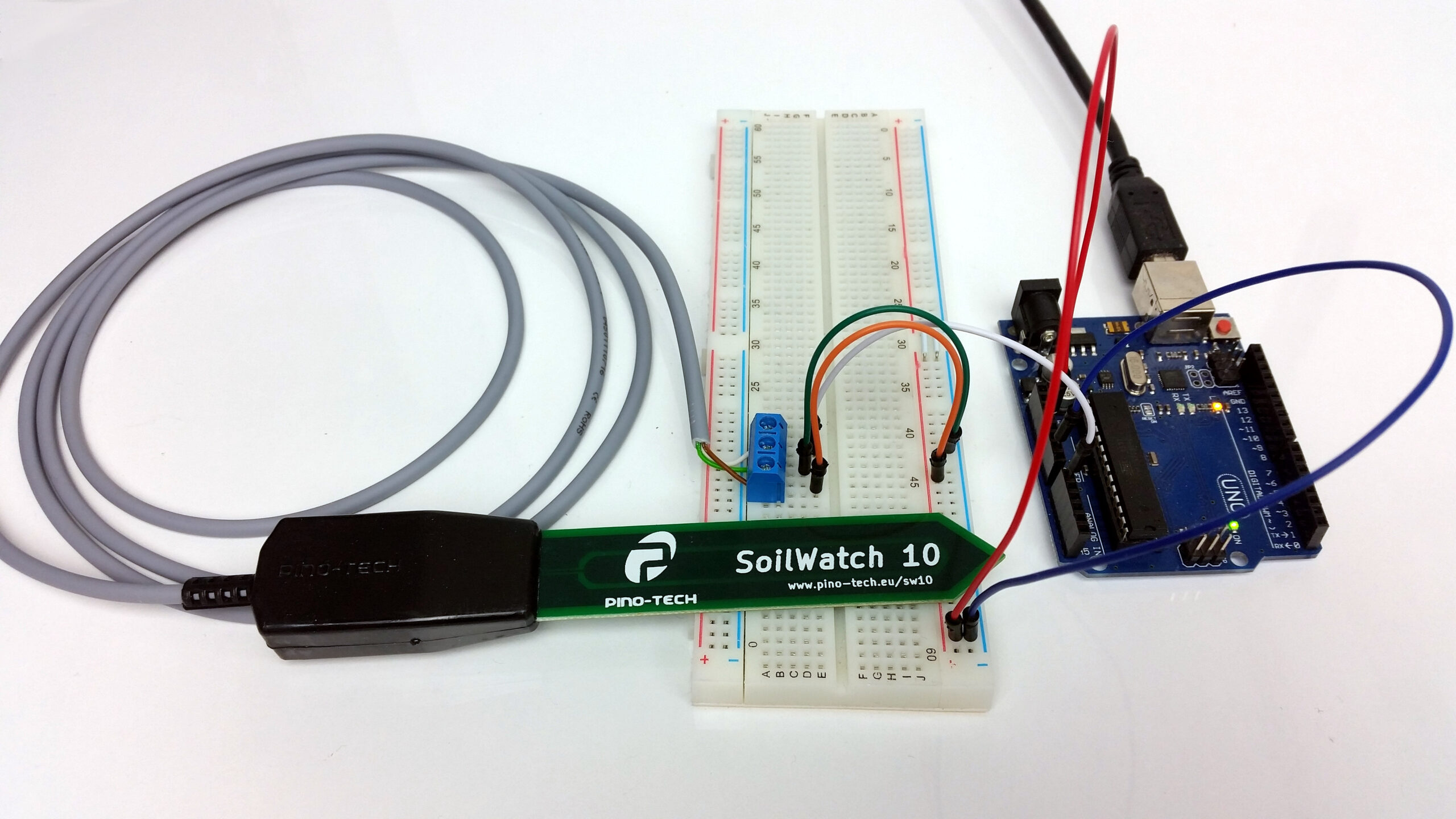
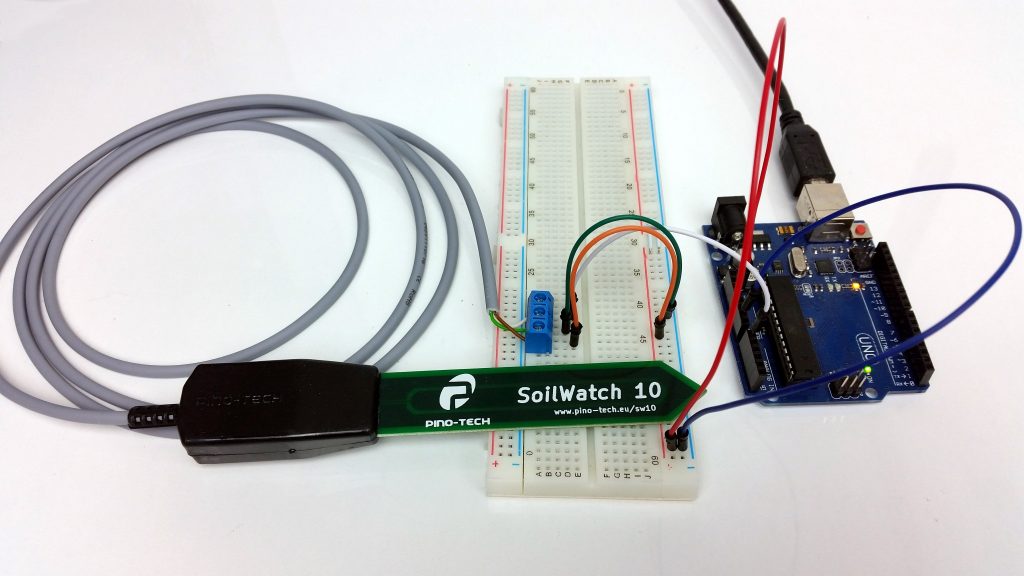
Please Note: This listing includes the SoilWatch 10 sensor only. Accessories like Arduino, LCD, or breadboards shown in application photos are for demonstration and are not included.
Features
-
High-Frequency 75MHz Capacitive Sensing: Provides stable, high-precision readings that are significantly less affected by soil salinity and mineral content than standard low-frequency sensors.
-
Engineered for Durability: Designed with no exposed electrodes, it eliminates corrosion entirely and will last years longer than cheap resistive soil moisture sensors.
-
Fully Waterproof: The rugged, sealed design allows for permanent outdoor installation and long-term burial in harsh soil conditions without degradation.
-
Easy Integration: Compatible with any microcontroller featuring an integrated ADC (Arduino, ESP32, etc.). Provides a reliable analog output (0-1.1V or 0-3V) for simple interfacing with your favorite boards.
-
Low Power Consumption: Optimized for battery-powered remote monitoring stations and long-term IoT deployments where power efficiency is critical.
Applications:
-
Smart Irrigation Management: Automate your watering schedule for gardens, greenhouses, or agricultural fields to save water and improve plant health.
-
Advanced Soil Moisture Monitoring: Ideal for environmental research, landscaping, and urban farming where consistent, long-term data is required.
-
Custom IoT Devices: The perfect moisture probe for Arduino, ESP32, Raspberry Pi, and Home Assistant smart home setups.
-
Commercial Landscaping: Monitor soil health across large parks or vertical gardens with a sensor that requires zero maintenance.
Specification:
Voltage: 3.1 – 5.0V (absolute maximum 5.5V)
Output: (0 – 3.0V) or (0 – 1.1V) (approximately)
Current: ~15mA
Startup time: <25ms
Operating temperature: -20°C to 80°C (readings below 0°C are meaningless)
Dimensions: 170x25x25mm
Weight: ~52g, ~120g, ~210g, ~400g
Cable: 1.5m, 5m, 10m, 20m
Connections:
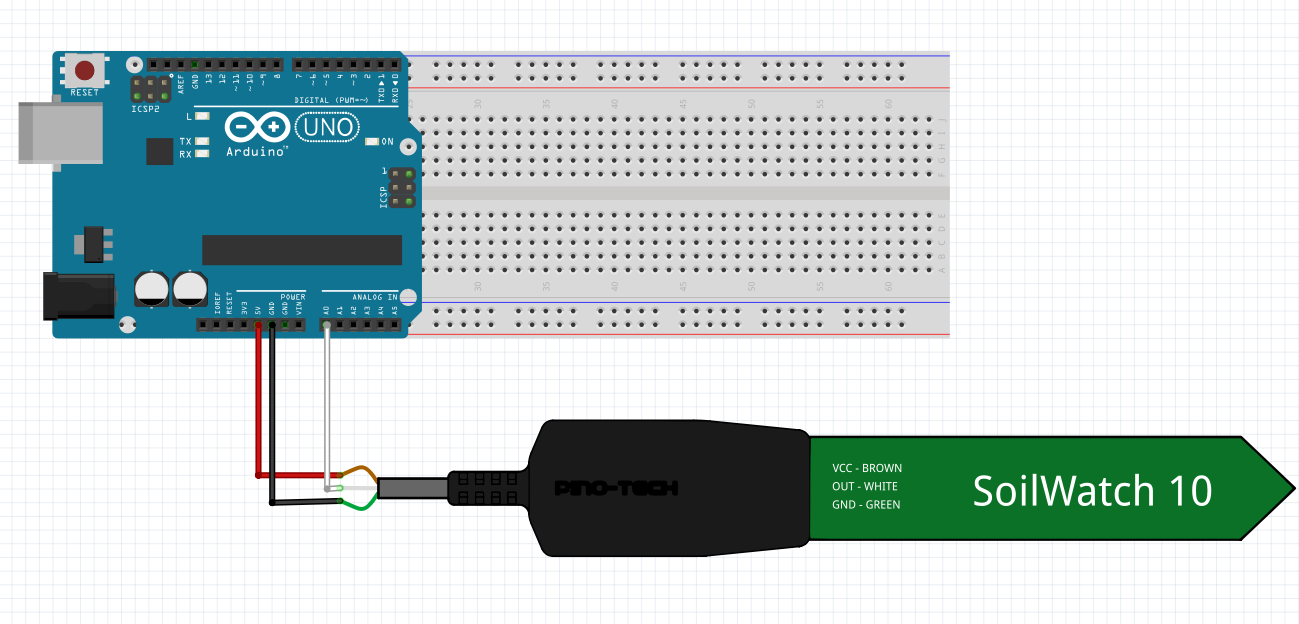
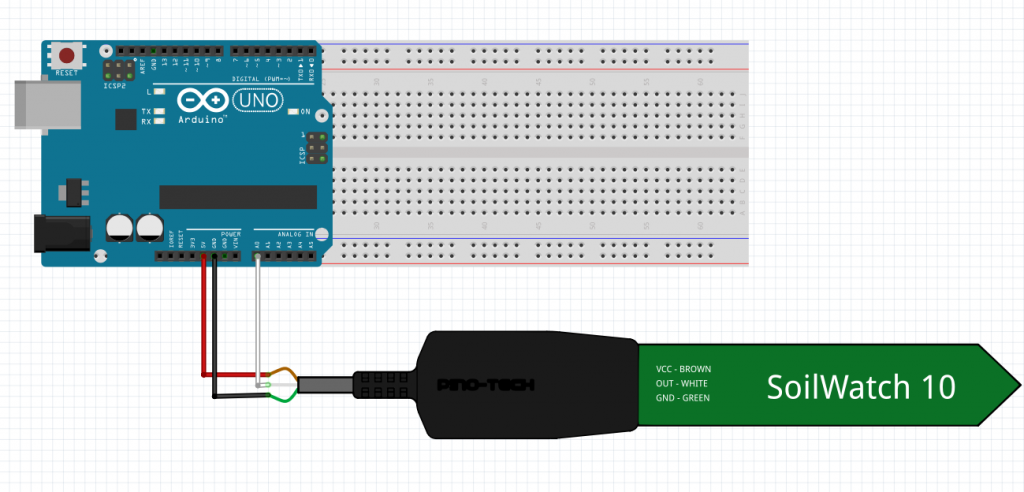
- Brown – VCC (+)
- Green – VDD (-)
- White – Output
Raspberry Pi
Experience the power of SoilWatch 10 alongside your Raspberry Pi with ease, thanks to its compatibility with external analog-to-digital converters (ADC). Simply integrate popular ADC options such as ADS1115 or MCP3008 breakout boards for seamless connectivity. Unlock the full potential of your soil moisture monitoring with SoilWatch 10 and Raspberry Pi, a dynamic duo for data-driven gardening and agriculture.
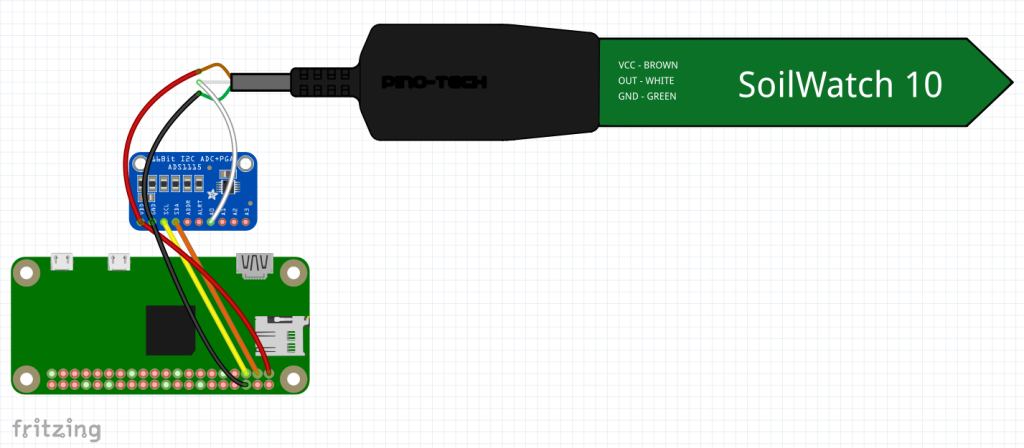
Python script for use with Raspberry Pi + ADS1115
#
# PINO-TECH - SoilWatch 10
#  Raspberry Pi + ADS1115
#
# To run this script the ADS1115 library needs to be installed
# Use the command below to install the library
# sudo pip3 install adafruit-circuitpython-ads1x15
#

import time
import board
import busio
import adafruit_ads1x15.ads1115 as ADS
from adafruit_ads1x15.analog_in import AnalogIn

i2cbus = busio.I2C(board.SCL, board.SDA)
ads = ADS.ADS1115(i2cbus)

# Set analog chanel
ch0 = AnalogIn(ads, ADS.P0)
#ch1 = AnalogIn(ads, ADS.P1)

while True:
    #calculate the Volumetric Water Content
    vwc = 2.8432*ch0.voltage**3 - 9.1993*ch0.voltage**2 + 20.2553*ch0.voltage - 4.1882
    #round vwc to 2 decimals
    vwc = round(vwc, 2)
    print("Voltage: ", round(ch0.voltage, 3), "%VWC: ", vwc)
    time.sleep(0.3)
ESPHome + Home Assistant
Connect SoilWatch 10 to your Home Assistant system using ESPHome for easy integration. Monitor soil moisture levels effortlessly and add a practical touch to your gardening setup. Enjoy the convenience of technology and nature working together seamlessly with SoilWatch 10 and Home Assistant.
Sample yaml configuration file – sensor section only
sensor:
  # SoilWatch 10 - Pino-Tech - Soil Moisture Sensor 1
  - platform: adc
    pin:
      number: GPIO36 #change to your GPIO (GPIO36 - VP pin on ESP32 DEVKIT V1)
      allow_other_uses: true
    name: "Soil humidity"
    icon: "mdi:water"
    attenuation: 11db
    update_interval: 0.1s
    unit_of_measurement: '%VWC'
    filters:
    - calibrate_polynomial:
        degree: 2
        datapoints:
        - 0.2 -> -0.48
        - 0.6 -> 5.27
        - 1.0 -> 9.71
        - 1.4 -> 13.94
        - 1.8 -> 19.04
        - 2.2 -> 26.12
        - 2.6 -> 36.26
        - 3.0 -> 50.55
    # updates sent = (update_interval * send_every) 0.1s * 100 = 10s
    - sliding_window_moving_average:
        window_size: 100
        send_every: 100
        send_first_at: 100
Made in POLAND!
Our sensor is being assembled and tested in-house. This allows us to have full control
over the quality of our product.
Download:
Datasheet: SoilWatch10
Frequently Asked Questions – SoilWatch 10
How is SoilWatch 10 different from cheap capacitive sensors?
Is the SoilWatch 10 output linear?
Can I use this sensor with a Raspberry Pi?
How long will the sensor last underground?
Does it work with Home Assistant and ESPHome?
Can it measure moisture in frozen soil?
Does cable length affect the accuracy of the moisture readings?
Can I use the SoilWatch 10 with 3.3V microcontrollers like the ESP32?
How deep should I bury the sensor?
Does the SoilWatch 10 require calibration?
Can I power the sensor only when taking a measurement to save battery?
Is the sensor compatible with highly acidic or alkaline soils?
Can the SoilWatch 10 be used in hydroponics or coco coir?
What is the benefit of the 75MHz frequency over standard sensors?
Can I cut the cable or extend it myself?
Is the SoilWatch 10 compatible with 5V Arduino boards?
What happens if the supply voltage fluctuates?
Does it measure soil temperature as well?
Is there a digital version (I2C or RS485) available?
How do I clean the sensor after use?
Can it be used to measure moisture in compost piles?
Does the sensor work in sandy or clay-heavy soils?
What is the maximum voltage I can apply?
How many sensors can I read with one microcontroller?
Is it safe for use around edible plants and vegetables?
Can I use it to detect water leaks under floors?
Does it require a specific orientation when buried?
Is the sensor affected by nearby metal objects?
Arduino Examples:
Volumetric Water Content:
/*
  SoilWatch 10 soil moisture sensor example - VWC

  Reads analog value of soil moisture sensor and displays it
  on the serial port.

  The circuit:
  Sensor output (white wire) connect to Analog A0 on Arduino.
  Connect VCC (brown wire) to 3.3V or 5V on Arduino (3.3V gives more stable readings)
  Connect GND (green wire) to GND on Arduino.

  created 30 Aug. 2017
  last updated 1 Jun 2021
  by Piotr Trembecki
  https://pino-tech.eu/sw10

  This example code is in the public domain.

*/

/*
******** SETUP ********

  For 1.1V version set is1V1Output to true. The usual maxADC value will be around 1000.
  For 3V version set is1V1Output to false. The usual maxADC value will be around 600.

***********************
*/
const int analogInPin = A0;           // Analog input pin that the sensor output is attached to (white wire)
bool is1V1Output = false;             // set true if 1.1V output sensor is used for 3V set to false
float refVoltage = 5;                 // set reference voltage - by default Arduino supply voltage (UNO - 5V)

int rawValue;
float voltage, vwcValue;

void setup() {
  // initialize serial communications at 9600 bps:
  Serial.begin(9600);

  if (is1V1Output == true)
  {
    analogReference(INTERNAL); //set ADC reference to internal 1.1V
    refVoltage = 1.1;
  }
}

void loop() {
  // read the moisture value:
  rawValue = analogRead(analogInPin);

  voltage = rawValue * refVoltage / 1023.0f;

  // print ADC results to the serial monitor:
  Serial.print("RAW ADC = " );
  Serial.print(rawValue);
  Serial.print(", " );

  // print mapped results to the serial monitor:
  Serial.print("Voltage = " );
  Serial.print(voltage);
  Serial.print(", " );

  if (is1V1Output == true)
  {
    //multiply the voltage to mach 3V version VWC equation of the sensor
    voltage = voltage * 2.94;

  }

  //VWC equation is suitable for most mineral soils - most mineral soils will saturate around 35-50% VWC
  vwcValue = (2.8432f * voltage * voltage * voltage) - (9.1993f * voltage * voltage) + (20.2553f * voltage) - 4.1882f;


  // print VWC results to the serial monitor:
  Serial.print("Moisture VWC [%] = " );
  Serial.println(vwcValue);

  // wait 500 milliseconds before the next loop
  delay(500);
}
Simple moisture example:
/*
  SoilWatch 10 soil moisture sensor example - Simple

  Reads analog value of soil moisture sensor and displays it
  on the serial port.

  The circuit:
  Sensor output (white wire) connect to Analog A0 on Arduino.
  Connect VCC (brown wire) to 3.3V or 5V on Arduino (3.3V gives more stable readings)
  Connect GND (green wire) to GND on Arduino.

  created 30 Aug. 2017
  last updated 9 Feb 2018
  by Piotr Trembecki
  https://pino-tech.eu/sw10

  This example code is in the public domain.

*/

/*
******** SETUP ********

  For 1.1V version set is1V1Output to true. The usual maxADC value will be around 1000.
  For 3V version set is1V1Output to false. The usual maxADC value will be around 600.

***********************
*/
const int analogInPin = A0;           // Analog input pin that the sensor output is attached to (white wire)
int minADC = 0;                       // replace with min ADC value read in air
int maxADC = 600;                     // replace with max ADC value read fully submerged in water
bool is1V1Output = false;             // set true if 1.1V output sensor is used for 3V set to false


int moistureValue, mappedValue;

void setup() {
  // initialize serial communications at 9600 bps:
  Serial.begin(9600);

  if (is1V1Output == true)
    analogReference(INTERNAL); //set ADC reference to internal 1.1V
}

void loop() {
  // read the moisture value:
  moistureValue = analogRead(analogInPin);

  // print ADC results to the serial monitor:
  Serial.print("ADC = " );
  Serial.print(moistureValue);
  Serial.print(", " );

  mappedValue = map(moistureValue, minADC, maxADC, 0, 100);

  // print mapped results to the serial monitor:
  Serial.print("Moisture value = " );
  Serial.println(mappedValue);

  // wait 500 milliseconds before the next loop
  delay(500);
}

Marinus (verified owner) –
Great (after sales) service and perfect product
Santiago P. (verified owner) –
Piotr does a great support for his products, I will buy again of course!
Roel Knol (verified owner) –
This is my second order of these sensors because these are the only soil moisture sensors which are affordable and will work month after month. Highly recommended.
By the way, I ordered them not because the first ones were broken, but because I am expanding my garden system.
ETIENNE CÁRDENAS (verified owner) –
I love this product, it is usually difficult to find sensors of this type that operate uniformly on different types of soil. He fulfilled all my expectations.
Carsten P. (verified owner) –
I bought one a gear ago and it works really good and stable. So now I bought a new for a new project😊
Anonymous (verified owner) –
Ove Brandt (verified owner) –
Dan H. (verified owner) –
I bought first 2 sensors to check it works as advertisement. It works very good: accurate, water proof and solid. Shipment is quickly. I am very satisfied with the purchase. So I buy 6 more. I bought sensors from all over the world. And PINO-TECH is the best one, both in term of quality and vendor attitude, at least for me. I will continue to buy from PINO-TECH in the future when I need more sensors.
Jozef (verified owner) –
Sivaprakash S (verified owner) –
Excellent sensor with reasonable price.
Jesper (verified owner) –
Phuong Ly (verified owner) –
SoilWatch 10 – Soil moisture sensor is good working for project me. Thank!
Anonymous (verified owner) –
stefanoelsner (verified owner) –
Awesome. Tried many, this is the only one that really works as expected.
It’s not cheap but worth every cent!
Adi Shalev (verified owner) –
Malfunctions after a few weeks, very bad experience.
Piotr Trembecki (store manager) –
We are sorry that your sensors failed. It does happen from time to time. We replace faulty sensors promptly. Please contact us to arrange the replacement.
SCIE CEDRIC (verified owner) –
OK GOOD
Bert (verified owner) –
Ordering and delivery went well and the sensor works!
Matti Jääaro (verified owner) –
Only used for a few days but seems well calibrated and stable. Good build quality.